
6 Facets Of Truly Caring Conversations

Most of us want to be caring in our conversations, but what does that really mean?
Some conversations are just catch-up conversations. Both people share whatever they like, maybe what they have been up to, their concerns, or plans they are making... they connect simply by visiting with each other.
Deeper conversations take a turn when one person chooses to focus on the other. This kind of conversation has 6 possible facets. (For the record, these are coaching conversations. They may not be formal coaching sessions, but they reflect a coaching culture.)
These types of conversations can be between friends and family members; they can be with co-workers or even acquaintances. They can happen intentionally by setting time aside, or on the fly as a connection is made in an airport, checkout line, or over a fence in a yard. Some of my favorites are with grandchildren, but they can also include conversations with aging parents or adult children.
Anytime intentional conversation is chosen...
Dealing With Doubts? Are You Like Me?
Are you an active believer who sometimes struggles with swirling thoughts? Sometimes, I am.
Sometimes I feel like I was really supposed to do something, but then the outcome wasn't what I hoped for.
I wonder if I missed it. And then I wonder if it was a test. Or maybe what happened was a stepping stone pointing me to something new I couldn't have seen without it. (See what I mean about the swirling thoughts?) How are you supposed to know?
I wish I could KNOW what to do every time and just do the right thing in the first place.
I feel that way about helping others too. I want to give them good advice to get the outcomes they are looking for. I want them to be sure about what they are doing every time and just do the next right thing.
If you are like me, these mental struggles then lead to questions like, "Why does it seem so hard to hear from God?" and "How can I help others if my own life has struggles?"
Understanding Coaching Culture shifted how I feel about my own journey AND...
Coach Training "lite" now available!
When I first took coach training years ago, I was changed and challenged by the concepts. I noted two things:
1) Coaching is an impactful way to actually help people grow. I saw how actively listening, asking empowering questions, and helping people move toward what God had for them worked WAY BETTER than feeling like I had to make things better for people.
2) Coaching is actually Biblical. God offers us all free will, and the best way to help someone toward their best next steps is to get out of the position of middleman, trying to tell them what they should do, and instead walk with them as they learn to discern.
I saw how the discipleship concepts that make up coaching culture could benefit so many believers as they interact with those around them.
I had taken several sessions of coach training to learn what I learned and was talking to God one day about how I wished there was a way to forward these concepts without people having to take multiple courses. I felt God challenge m...
How Does Discerning Work For You?

We all face stuff... Maybe it's a decision to be made, a goal to invest in, or perhaps you are facing a relational challenge.
Whatever it is. God wants to use it for good in your life.
He wants to connect with you in new ways. He wants to reveal Himself in some new way - maybe Counselor, or Friend, or Sustainer, or...
I kind of have a love/hate relationship with that familiar verse. You know the one - Romans 8:28, where God promises to use it all for good in our lives. If I'm honest, I sometimes have a different definition of "good". I don't want difficult stuff in my life, and even more so, I don't want my people to have it either.
I want all my people to be healthy, wealthy, and wise! :)
Turns out, though, we all learn and grow more through our difficulties than when things are easy. I'd rather learn from stories of others who were overcomers than have to face overcoming myself.
Guess that makes me human:)
It's complicated, though. On the one hand, we want things to go smo...
How Do You Actually Maintain the Gain?
Tags: coaching tools, road model, dedication, maintain the gain, christian coaching, coach training
Most change doesn't fail on day one. It fails around day seventeen.
The first conversation goes great. Someone recognizes what's really going on, takes ownership of their part, and commits to a concrete action. And it works — for a while. Then life gets loud again, the old pattern feels easier, and slowly, without anyone deciding to quit, the gain disappears.
Dedication is the "D" in ROAD, and it might be the most overlooked of all four letters, because by the time you get here, the hard emotional work already feels done. It isn't.
The parable that's really about this
In Matthew 13, Jesus tells the parable of the sower — seed scattered on different kinds of ground. Some of it springs up quickly on rocky soil, looks promising, and then withers because it "has no root." That image has stuck with me for years, because it describes almost every failed New Year's resolution, every b...
Insight Isn't the Finish Line
Some of the best conversations I've ever had ended with absolutely nothing changing.
Someone had a real breakthrough. You could see it — the shift in their face, the "I never thought about it that way" moment. And then... life happened, the week got busy, and three months later, they're right back where they started.
That's what happens when a conversation stops at insight and never makes it to Action — the "A" in ROAD.
Why a good "aha" moment isn't enough
An aha moment feels like progress, and in a way, it is. Recognizing something new about your situation and taking ownership of your part in it are both real, necessary steps. But insight without action is just an interesting thought you had once. James put it plainly: "Do not merely listen to the word... Do what it says" (James 1:22). Understanding something and living differently because of it are two separate steps, and the gap between them is where most good intentions quietly die.
The trap of "someday"
Vague resolve doesn't...
Whose Job Is It to Actually Change?
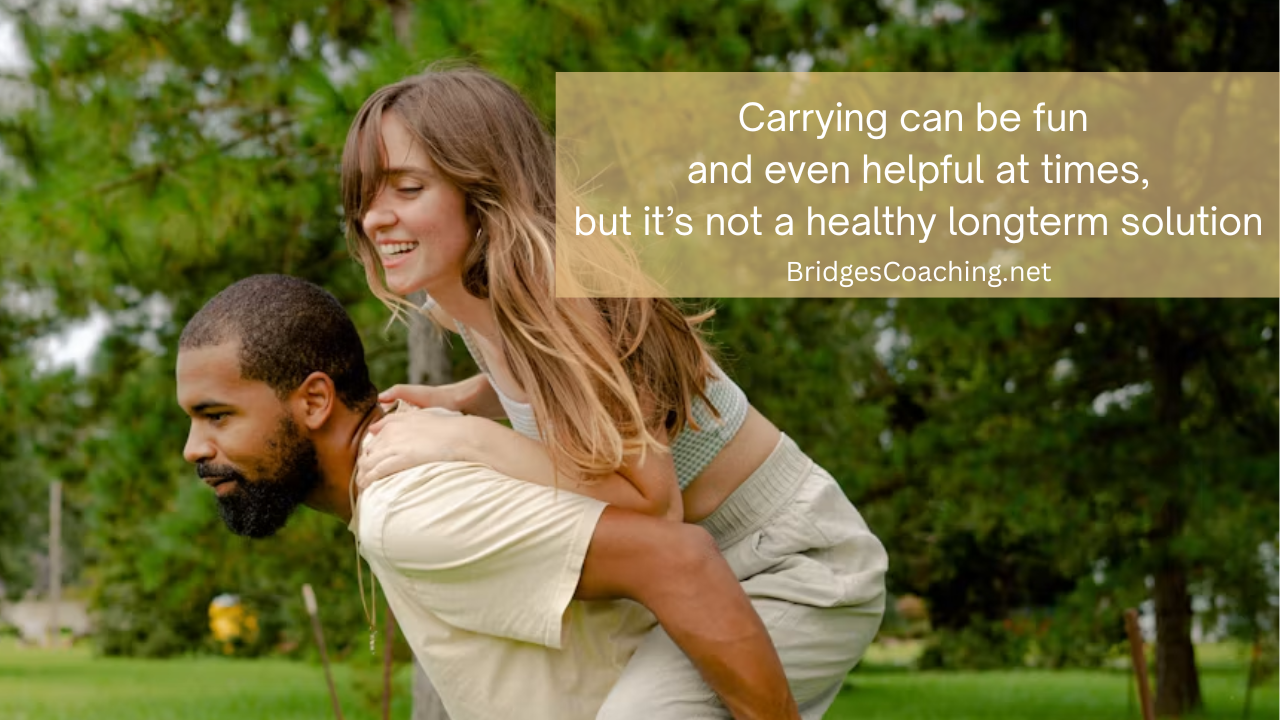
It sounds loving. It often comes from a genuinely loving place. But it also happens to be the fastest way to keep someone dependent instead of helping them grow.
Ownership is the "O" in ROAD, and it might be the hardest letter of the four — because it asks you to care deeply about someone's outcome while refusing to carry it for them.
Care without carrying
There's a real tension here, and Scripture actually holds both sides of it. Galatians 6:2 tells us to "carry each other's burdens." A few verses later, Galatians 6:5 says "each one should carry their own load." Both are true at the same time. Support is real. But so is the fact that some things are simply not yours to carry.
Ownership is the practice of telling the difference — in the moment, in a real conversation — between
...The Skill Most People Skip: Learning to Actually Recognize What's Going On

We've all been there.
Someone starts venting to you. Within about ten seconds, you already know what they should do.
Maybe you're right. Maybe you're not. But here's what I've noticed after years of coaching conversations: the moment you jump to a solution, you've usually skipped the most important step in the whole conversation — helping the person actually recognize what's going on.
Recognition is the "R" in the ROAD framework we teach at Bridges — Recognition, Ownership, Action, Dedication. It's the step almost everyone skips, because it feels like the slow part. It isn't the part where anything gets fixed. It's the part where someone finally sees clearly.
Why skipping this step backfires
Think about the last time someone gave you advice before you'd even finished explaining your situation. It probably didn't land — not because the advice was bad, but because you weren't done recognizing the problem yet. You were still figuring out what was actually going on underneath it all.
...What If "It" Would Make All The Difference? All 6 Reporter Questions

If you have ever thought about coach training, or even never thought about it, these Q's are for you!
1. WHO should consider coach training?
If you are a parent, pastor, marketplace leader, small group leader, have neighbors, or family relationships, coach training can enhance every conversation and enable your influence to have a deep kingdom effect!
Want more: Why Hermits Don't Need Coach Training (And Five Reasons Other People Love It!)
2. WHAT does it cover?
Coach Training includes a foundational study of Active Listening and Asking Powerful Questions, then goes on to the principles given in the ROAD acronym. The power of Recognizing what to focus on, the empowering personal agency of Ownership, developing Action Steps, and then maintaining the gain of Dedication.
All these tools can be used in casual conversation as well as coaching sessions.
3. WHEN would be a good time to take it?
Maybe that is a question only you can answer, but I will say that if you wait until you ha...
Does True Coaching Include Coaxing?

Merriam-Webster defines coaxing as: the act of gently and persistently persuading someone to do something using patience, kindness, flattery, or encouragement. Instead of using force or coercion, it involves appealing to someone's emotions or offering small incentives to overcome their reluctance.
So, does coaching include coaxing? The answer isn't as clean-cut as you may think.
A coach is a thinking partner. Their job is to come alongside someone to create a conversational space where the person can move forward in an area they choose to focus on. Remember, the word coaching comes from the idea of forward movement. "Coaching" from one place to another - like a stagecoach taking people from one place to another.
The person chooses to get coached to move from where they are to another place. That place could include anything from a specific project goal to a mindset shift, or from making a quality decision to walking through a transitional season l. Truly, any forward movement can ...