
Insight Isn't the Finish Line
Some of the best conversations I've ever had ended with absolutely nothing changing.
Someone had a real breakthrough. You could see it — the shift in their face, the "I never thought about it that way" moment. And then... life happened, the week got busy, and three months later, they're right back where they started.
That's what happens when a conversation stops at insight and never makes it to Action — the "A" in ROAD.
Why a good "aha" moment isn't enough
An aha moment feels like progress, and in a way, it is. Recognizing something new about your situation and taking ownership of your part in it are both real, necessary steps. But insight without action is just an interesting thought you had once. James put it plainly: "Do not merely listen to the word... Do what it says" (James 1:22). Understanding something and living differently because of it are two separate steps, and the gap between them is where most good intentions quietly die.
The trap of "someday"
Vague resolve doesn't...
Whose Job Is It to Actually Change?
It sounds loving. It often comes from a genuinely loving place. But it also happens to be the fastest way to keep someone dependent instead of helping them grow.
Ownership is the "O" in ROAD, and it might be the hardest letter of the four — because it asks you to care deeply about someone's outcome while refusing to carry it for them.
Care without carrying
There's a real tension here, and Scripture actually holds both sides of it. Galatians 6:2 tells us to "carry each other's burdens." A few verses later, Galatians 6:5 says "each one should carry their own load." Both are true at the same time. Support is real. But so is the fact that some things are simply not yours to carry.
Ownership is the practice of telling the difference — in the moment, in a real conversation — between
...The Skill Most People Skip: Learning to Actually Recognize What's Going On
We've all been there.
Someone starts venting to you. Within about ten seconds, you already know what they should do.
Maybe you're right. Maybe you're not. But here's what I've noticed after years of coaching conversations: the moment you jump to a solution, you've usually skipped the most important step in the whole conversation — helping the person actually recognize what's going on.
Recognition is the "R" in the ROAD framework we teach at Bridges — Recognition, Ownership, Action, Dedication. It's the step almost everyone skips, because it feels like the slow part. It isn't the part where anything gets fixed. It's the part where someone finally sees clearly.
Why skipping this step backfires
Think about the last time someone gave you advice before you'd even finished explaining your situation. It probably didn't land — not because the advice was bad, but because you weren't done recognizing the problem yet. You were still figuring out what was actually going on underneath it all.
...How Word Pictures Can Shift Worldviews

"A picture is worth a thousand words" is really true, maybe even more so for word pictures!
God used word pictures throughout the Bible. He compares His care to being a shepherd, His strength to being a strong tower, and His forgiveness to making us whiter than snow - to name a few. Jesus was a big fan of word pictures as well. In fact, it seems He used what was around Him to share kingdom principles more often than direct teaching. Maybe because word pictures stick in our minds? They are easy to recall and often add depth to a concept's meaning. Think about the yeast in the dough, the vine and the branches, the seed sown in different kinds of soil, - we could go on and on.
It should come as no surprise, then, that God still wants to reveal truth to us through word pictures.
In my own life, I can recall many times when a word picture has helped me anchor my soul in a time of need. I remember one time when I was particularly overwhelmed. I was writing curriculum and recording lesso...
Coaching Tools And How They Can Help
All good coaching allows the person being coached to choose their pathway, and most good coaching allows the "client" to choose the goal.*
But what happens when the person being coached really isn't sure how to move forward? Maybe they don't know what goal they want, or maybe they aren't sure how to take steps forward. Let's take a look at both scenarios.
1) Choosing a goal
At Bridges, we share three ways to choose a goal. The first is a tool called the Bridges Coaching Wheel of Life. It offers a personal evaluation process that provides a well-rounded view of a person's satisfaction in various areas of their life. Click the green link above for your FREE copy. We also offer an expanded version in our Life On Purpose personal workshop or the Traction book.
The second is taking a dream out of the "dream cloud," planting it in the ground, and tending it. That could mean anything from a project like writing a book to adding on to your home, or pursuing an education or a promotion. Th...
Does True Coaching Include Coaxing?
Merriam-Webster defines coaxing as: the act of gently and persistently persuading someone to do something using patience, kindness, flattery, or encouragement. Instead of using force or coercion, it involves appealing to someone's emotions or offering small incentives to overcome their reluctance.
So, does coaching include coaxing? The answer isn't as clean-cut as you may think.
A coach is a thinking partner. Their job is to come alongside someone to create a conversational space where the person can move forward in an area they choose to focus on. Remember, the word coaching comes from the idea of forward movement. "Coaching" from one place to another - like a stagecoach taking people from one place to another.
The person chooses to get coached to move from where they are to another place. That place could include anything from a specific project goal to a mindset shift, or from making a quality decision to walking through a transitional season l. Truly, any forward movement can ...
Coaching For Everyday Conversations
If you know coaching, you probably know at least some of the basic tenets. In our Coaching culture training, we dig into the pillars of Active Listening and Asking Powerful Questions. This alone is most often an intense culture shift. It's much more common to offer a solution based on our own education or experience than to be present for someone and offer a space for them to talk through their situation.
And yet we all love to be heard.
And most of us prefer not to be told what to do. (Check out the blog on the "instawall".)
In our Life Coach Certification, we give trainees three goals for their first coaching sessions:
1. Ask the person being coached to come with a focus.
2. Ensure the person being coached does most of the talking (80% goal)
3. Complete the coaching with an action step of some sort - even if it is to come back to the next session with a list of possibilities
All these are valuable practices, but not very common.
*Try it! If you are not yet coach-trained, ...
Meet Kent: Bridges Alumni, Coach, Author and Originator
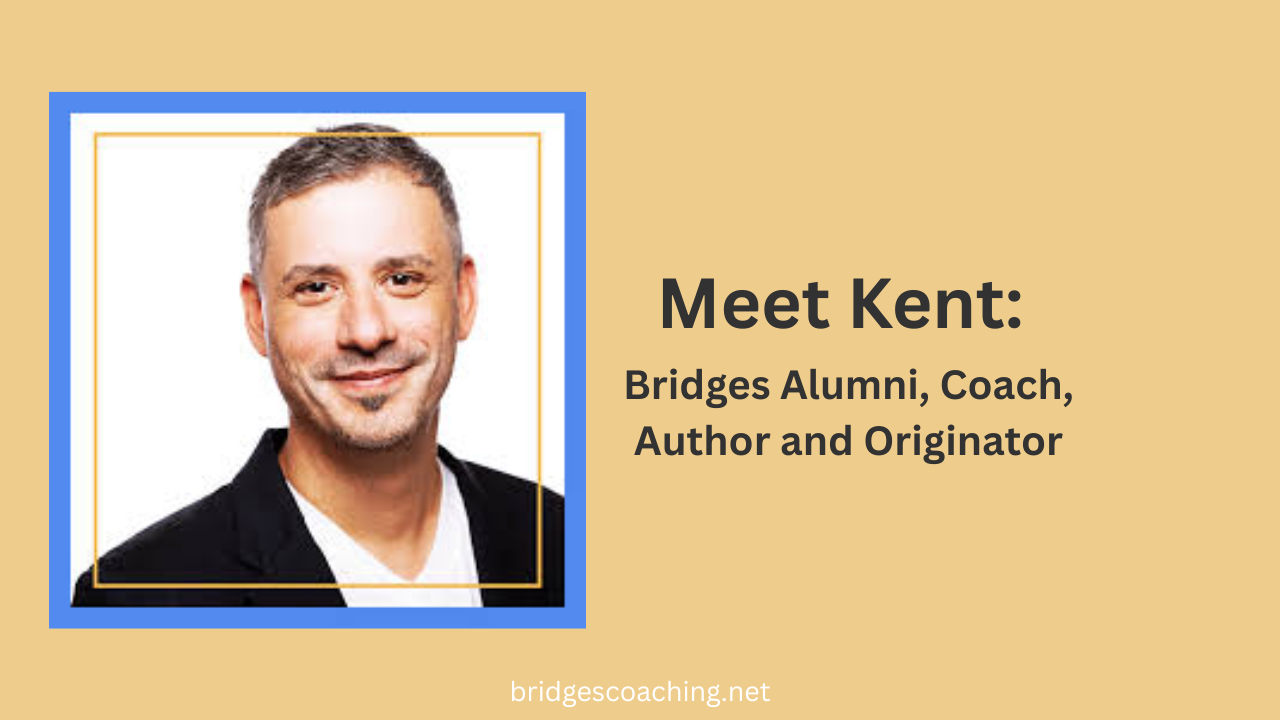
What's an originator? I'm glad you asked. (I may have made up the word.) An Originator is someone who creates original content. They have their own IP (Intellectual Property - I didn't make that one up.)
Kent originated the REST assessment and offers it for free! I would encourage you to take the assessment, but first let's hear his coach training story.
How did you first hear about coach training?
Honestly, two things were happening. First, I had been hearing about the coaching paradigm for a few years and had some respected friends who raved about it, including some friends who had trained with Bridges Coaching, and it piqued my interest. Being a voracious learner and practitioner, I get excited to learn new leadership skills. Second, I was kind of frustrated with old ministry paradigms. I wanted to see people get breakthroughs, but realized the old discipleship paradigm of “telling” doesn’t work with every personality. Additionally, had been thinking about doing coach training fo...
This Just In - Commentary On Coach Training

In the Bridges Life Coach certification course, we use a variety of adult learning techniques, and one of them is online discussion. We share different questions throughout the learning process so the trainees can interact with the material and process it by restating it, or sharing how it applies in their own life situations.
Among other things, we share about topics like why it is often hard to trust that God has a plan, what it looks like to actively listen in a real life situations, or how to ask empowering questions.
The following comment came from a list-building question requesting input on honest reasons we like to retain control. The trainee's words are in blue and italics.
I take control because apparently I know what's best for everyone!! I never knew I was such a know-it-all all when it comes to other people's lives! But it is out of concern and wanting what is best for them.
I love the honesty here! Whether we acknowledge it or not, most of us do think we know what...
Two SIMPLE Phrases That Flip The Conversation To A Coaching Mindset

There is a skill set to coaching, to be sure, but more than a skill set, coaching is a mindset.
More than following a formula, coaching* has to do with a heart posture that believes God's Spirit endwells people and is guiding each of us on our own unique journey. A good coach is a thinking partner who offers a safe space to process your pathway out loud. They are cheerleaders and sometimes mirror holders. They believe in your ability to work through whatever life has thrown at you, to do new things, to work through obstacles, and to follow through when the going gets tough.
Two super simple phrases that can be a game-changer in a coaching session or a conversation.
1) Tell me more.
Tell me more - offers the person replying to go anywhere they want to go in what they share next. In fact, they may not even know until they keep talking what they need to "get out" there to discuss.
Proverbs 20:5 says, "People’s thoughts can be like a deep well, but someone with understanding can f...